
Wondering if it still makes sense to buy that investment property? Ironbark Advice's Head of Advice Rebecca Mossman explains why nothing – and everything – has changed since the government handed down its budget.
For generations, Australians have had a love affair with property. The Federal Budget may have just complicated it.
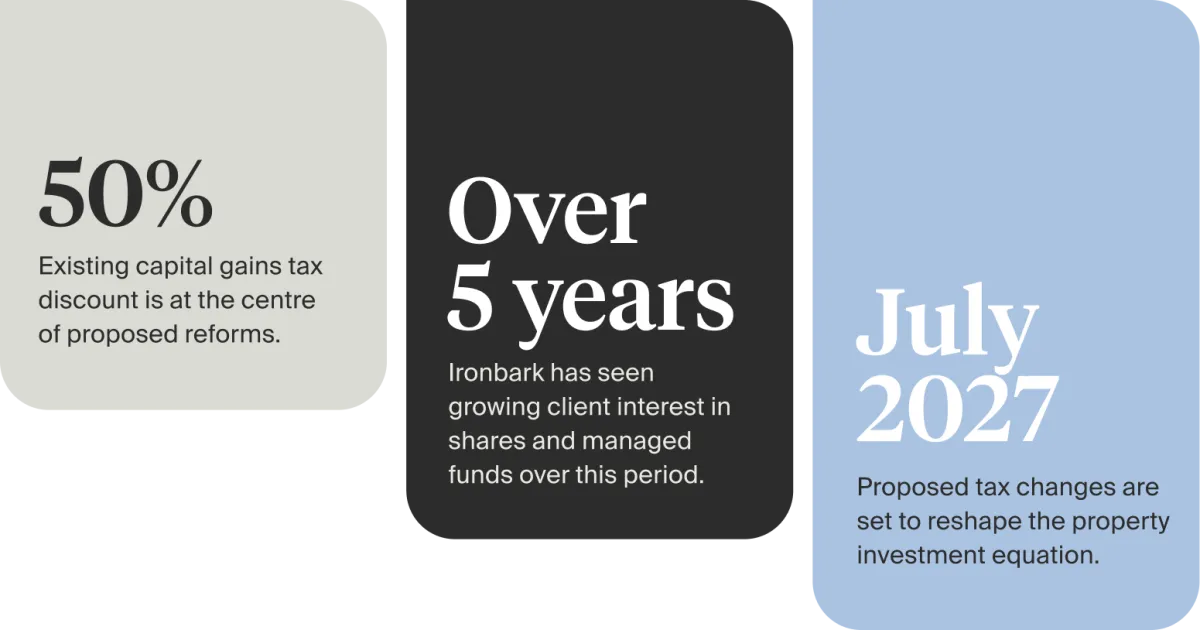
That’s because from July 2027, changes to negative gearing and capital gains tax will reduce some of the tax advantages associated with property investment – even as property prices stall or even fall across Australia.
For established properties bought after Budget night, investors will generally no longer be able to use rental losses to reduce the tax they pay on income such as their salary. Meanwhile, the 50% CGT discount will be replaced by inflation-based indexation, changing the tax equation when it comes time to sell.
It means many investors are once again weighing up whether shares or property offer a better path to long-term returns.
But focus too heavily on the upcoming changes to tax and you risk missing the bigger story.
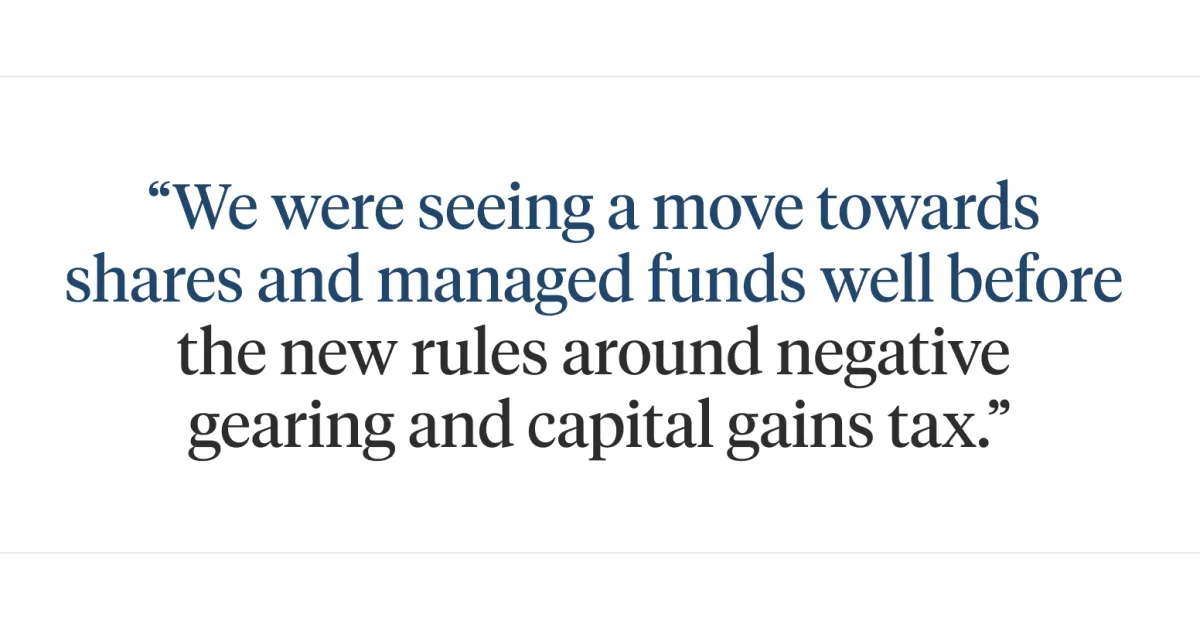
In fact, we were already seeing a move towards shares and managed funds well before the recent changes were announced. For us, the conversation started shifting about five years ago. Where clients had once overwhelmingly looked to investment property to build wealth, more were starting to ask how they could invest in shares instead.

The pull of the familiar
Why? Largely because of a shift in mindset.
Historically, people were put off by share portfolios and their visible volatility. They only had to look at their account balance to see the value move up or down on a daily basis, sometimes by sizeable amounts.
Property felt different. People could get an idea of their house’s value online, but they didn’t get a true valuation until they actually bought or sold. And the general perception was that property values would keep rising – despite that not always being the case.
Today, however, there is much more comfort around volatility. Social media is full of posts explaining market cycles and framing downturns as potential buying opportunities. That’s changed people’s thinking.
Superannuation has made a difference too. As one of the largest assets held by individual Australians – in some cases with a value even higher than the family home – it has increased engagement with how retirement savings are invested.
That has naturally helped more people understand how share portfolios work and boosted overall financial literacy.


The property equation
Other factors have been changing the equation for investors - and much of that has little to do with negative gearing or capital gains tax.
While an investment property can still look attractive on paper, the numbers aren’t always stacking up.
Property prices are now at a level where buying requires a substantial upfront commitment, including a large deposit. Add higher interest rates and relatively low rental yields – despite rents being high in dollar terms – and the pressure on household cash flow can be significant.
The real question is whether your family can carry that shortfall week to week. Often the answer is no. The shortfall between your mortgage repayments and the typically lower net rental income you receive can run into hundreds of dollars per week for the first few years of your loan. Without negative gearing in those early years, that shortfall may simply be unsustainable for many households.
The flexibility factor
By contrast, shares allow you to start at a level you can support and build from there.
With our clients, we start by asking what surplus cash they have each week and then match that to an appropriate investment strategy. This may involve investing in a share portfolio, managed fund, exchange traded fund (ETF), managed account or a combination of these options – starting with what’s available now and gradually building their portfolio over time.
That flexibility can make investing feel more achievable for some.


Weighing the trade-offs
There are other trade-offs to consider as well.
Shares can be more attractive because they are highly liquid – investors can generally access their money far more quickly than they can with property. They also offer much greater diversification across companies, sectors and markets.
On the other hand, there are fewer opportunities to leverage debt when investing in shares as banks generally prefer lending to secure assets like a house. And where investors do borrow to invest, that can introduce additional risk, with investors potentially left exposed to margin calls if values fall sharply. Therefore, it’s important to consider the long term value of either option with an expert.
Property comes with a different set of trade-offs. It requires active management. That can be both time-consuming and costly, with investors exposed to tenancy and maintenance issues. However, that ability to actively manage and improve a property can also create opportunities to add value over time.
Reduced diversification and liquidity are other issues to consider. For many people, an investment property represents a large amount of capital concentrated in a single asset in a set location and it can take months to sell a property, potentially putting you in a difficult spot if you need to access your money quickly.

Knowing what you want
This isn’t to say that investing in property can’t work for you. It all comes down to your personal goals, investment preferences and ultimately, the timeframe before you’ll likely need to access your capital.
It can still be appealing if it aligns with your overall strategy. It really comes down to your goals and what you’re trying to achieve.
For instance, buying a property in your 40s in an area where you eventually plan to retire can make a lot of sense – provided the numbers are sustainable.

Looking beyond tax
At the end of the day, no one likes paying tax. But it's important to take the emotion out of the decision and work through it step by step, considering the overall strategy.
Ultimately, you only get taxed on the profit.
Does it really make sense to rush in and firesale an asset prior to the upcoming changes for $60,000 less to avoid, say, $10,000 of tax?
Again, it comes back to the bigger picture.
For us, the most important thing is understanding each client’s specific situation – modelling the alternatives, understanding the trade-offs and putting forward the investment strategy that best fits their goals and cash flow.